- esabaqpk@gmail.com
- +92 (308) 463-2275
 WhatsApp: +92 (308) 463-2275
Blog Details


How to Write a CV With No Work Experience | eSabaq.pk
Create your first CV with confidence. Learn how to present your education, projects, and skills honestly, with a sample CV, fill-in template, and practical checklist.
You find an internship that sounds right for you. Then the application asks for a CV, and you pause: “What can I write when I have never had a job?”
You can still build a useful CV. Your education, projects, volunteering, and everyday responsibilities may provide evidence of the skills an employer needs. This guide explains how to write a CV with no work experience, with practical examples and a template you can adapt today.
How to write a CV with no work experience
Start with the role you want. Read its advertisement, identify the main requirements, and collect examples showing where you have practised those skills. Then organise your strongest evidence into clear sections.
For a first application, use this order:
- Name and contact details
- Short professional summary
- Education
- Relevant skills
- Academic or personal projects
- Volunteering and extracurricular activities
- Relevant certifications, if any
You do not need an empty “Employment History” section. The UK National Careers Service recommends drawing on projects and volunteering when applying for a first job.
Find experience you already have
Before formatting anything, list tasks you have actually completed. Think beyond formal employment:
- Tutoring: Explain the subject, learners, and materials you prepared. Identify informal or unpaid tutoring honestly.
- Family-business assistance: Describe maintaining stock records, answering enquiries, or organising orders. Do not invent a managerial title.
- University responsibilities: Include society events, group presentations, class coordination, or managing registrations.
- Personal projects: A small website, budget spreadsheet, writing portfolio, or research exercise can demonstrate practical ability.
Ask yourself: What did I do? Which tools did I use? What did I produce? Keep evidence, such as a presentation or spreadsheet, that you could discuss at an interview. Remove confidential information before sharing samples.
Build the essential sections
Contact details
Put your name, city, working phone number, and professional email at the top. Add LinkedIn or a portfolio only if it is relevant and ready for employers to view.
For most ordinary applications, omit your CNIC number, full street address, religion, marital status, and family details. Photos are generally unnecessary unless requested for a legitimate application requirement. Requirements vary, particularly for prescribed forms; check the employer’s instructions before supplying additional personal information.
Professional summary
Write two or three specific lines connecting your education and strongest evidence to the role.
Weak: “Hardworking fresh graduate seeking a challenging position in a reputable organisation.”
Improved, fictional example: “Business graduate seeking an operations internship. Used Excel to organise survey responses for a university project and maintained registration records as a student volunteer.”
The improved version gives the reader something concrete to assess. Avoid calling yourself an expert in a tool you have only recently started using.
Education
List your most recent qualification first, followed by the institution and dates. If you are still studying, give your expected completion date.
For a CV for fresh graduates, add relevant modules or a substantial project. Include grades when requested or when they strengthen your application. Use the correct grading scale and never imply that an unfinished degree is complete.
Relevant skills
Choose skills you can demonstrate: Excel formulas, presentation design, basic Python, customer communication, or languages. Replace vague ratings such as “90% communication” with evidence elsewhere in the CV.
Be accurate about language ability. If improving spoken English is part of your career plan, explore the eSabaq.pk English Language Course. Describe your present ability honestly while you develop it.
Projects, volunteering, activities, and certifications
For each relevant activity, include a title, organisation or context, dates, and one or two useful bullets. Explain your individual contribution to group work.
For certifications, give the exact course title, provider, and completion date. Label unfinished courses “in progress.” Include relevant completed training; collecting unrelated certificates does not replace evidence that you can perform a task.
Turn responsibilities into useful evidence
Use this simple pattern: action + task + method or result. Add numbers only when they are accurate and you can explain them. Oxford’s careers guidance also recommends evidence of your contribution and tailoring examples to the role.
These examples are fictional; replace them with your own facts:
| Weak wording | Stronger, honest wording |
|---|---|
| Good at Excel | Used Excel filters and SUM formulas to organise 80 survey responses for a university project. |
| Helped at an event | Maintained a registration list and checked in 35 attendees at a student workshop. |
| Excellent teaching skills | Prepared weekly mathematics practice sheets for two younger learners during informal tutoring. |
An outcome does not have to be a percentage increase. A completed report, accurate register, or working project can show what you contributed.
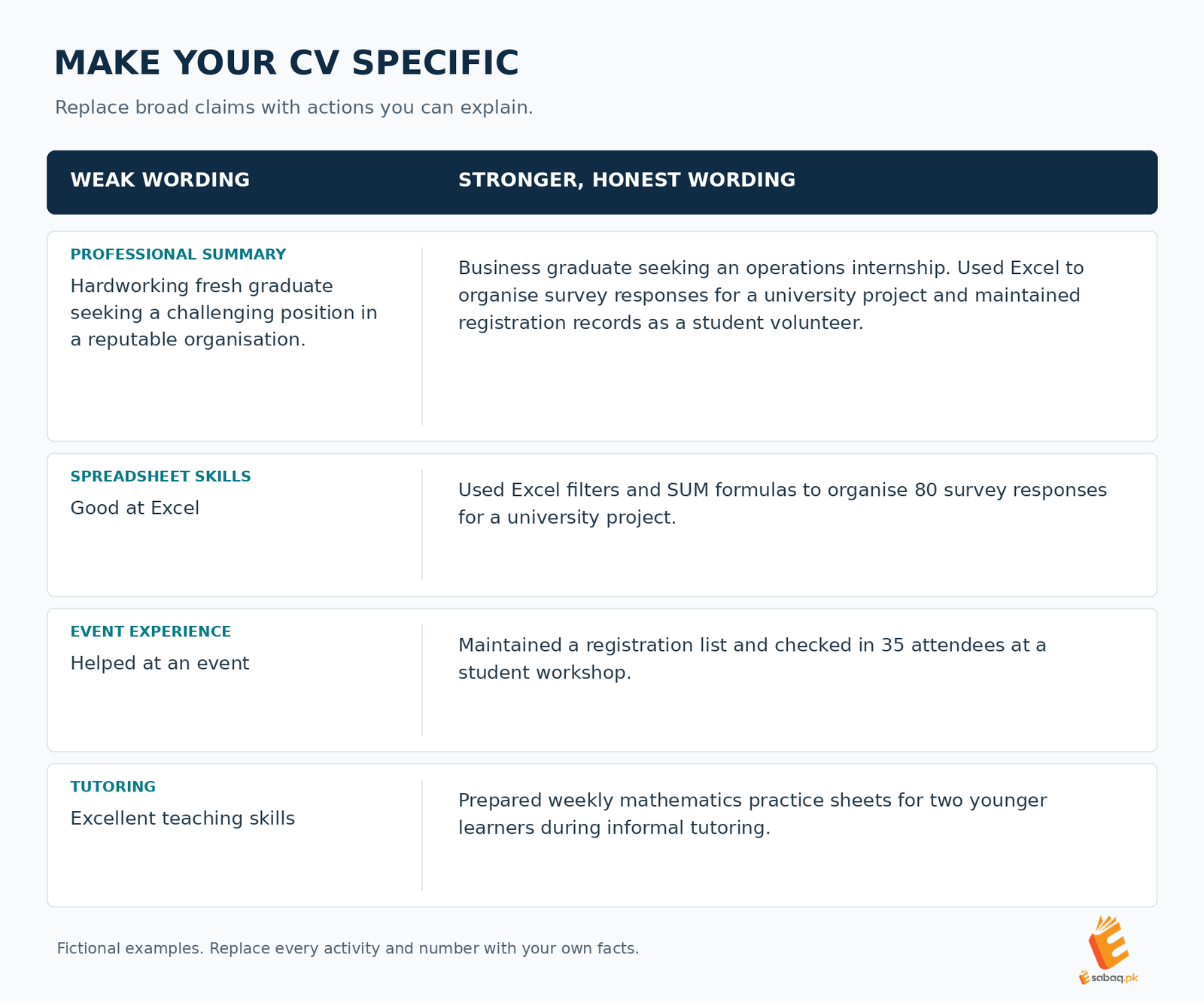
Illustrative wording only: use your own activities, tools, and numbers.
Tailor your CV to the advertisement
Imagine an operations internship asks for spreadsheet skills, record keeping, and teamwork. Put your relevant spreadsheet project and registration experience near the top. A design internship would need different evidence, such as a portfolio and design projects.
Use the employer’s terminology when it accurately describes your skills. If the advert says “Microsoft Excel” and you have used it, name it directly. Do not paste the entire advertisement into your CV or claim software knowledge you cannot demonstrate.
When preparing a CV for an internship in Pakistan, check eligibility, location, working hours, application deadline, and any student-status requirement. Tailoring includes deciding whether the opportunity fits you.
Keep formatting simple and readable
An applicant tracking system (ATS) is software employers use to manage applications. Some systems extract information from uploaded CVs. Greenhouse documents parsing problems with image-only CVs, columns, graphics, and complex layouts. A reading problem is not automatically a rejection.
For your first CV:
- Aim for one focused page; use a second only when relevant content genuinely needs it.
- Choose a readable font, around 11–12 points, with consistent spacing.
- Use a single column, standard headings, and short bullets.
- Keep contact details in the document body rather than a header or text box.
- Follow the requested file format. If none is specified, a selectable-text PDF is a practical option; retain an editable Word copy.
- Use a clear filename, such as Ayesha-Khan-Operations-Intern-CV.pdf.
Open the exported file and check the text can be selected. Review any fields the application form fills automatically. These checks help readability; no template guarantees an interview or acceptance by every ATS.
A complete first CV example
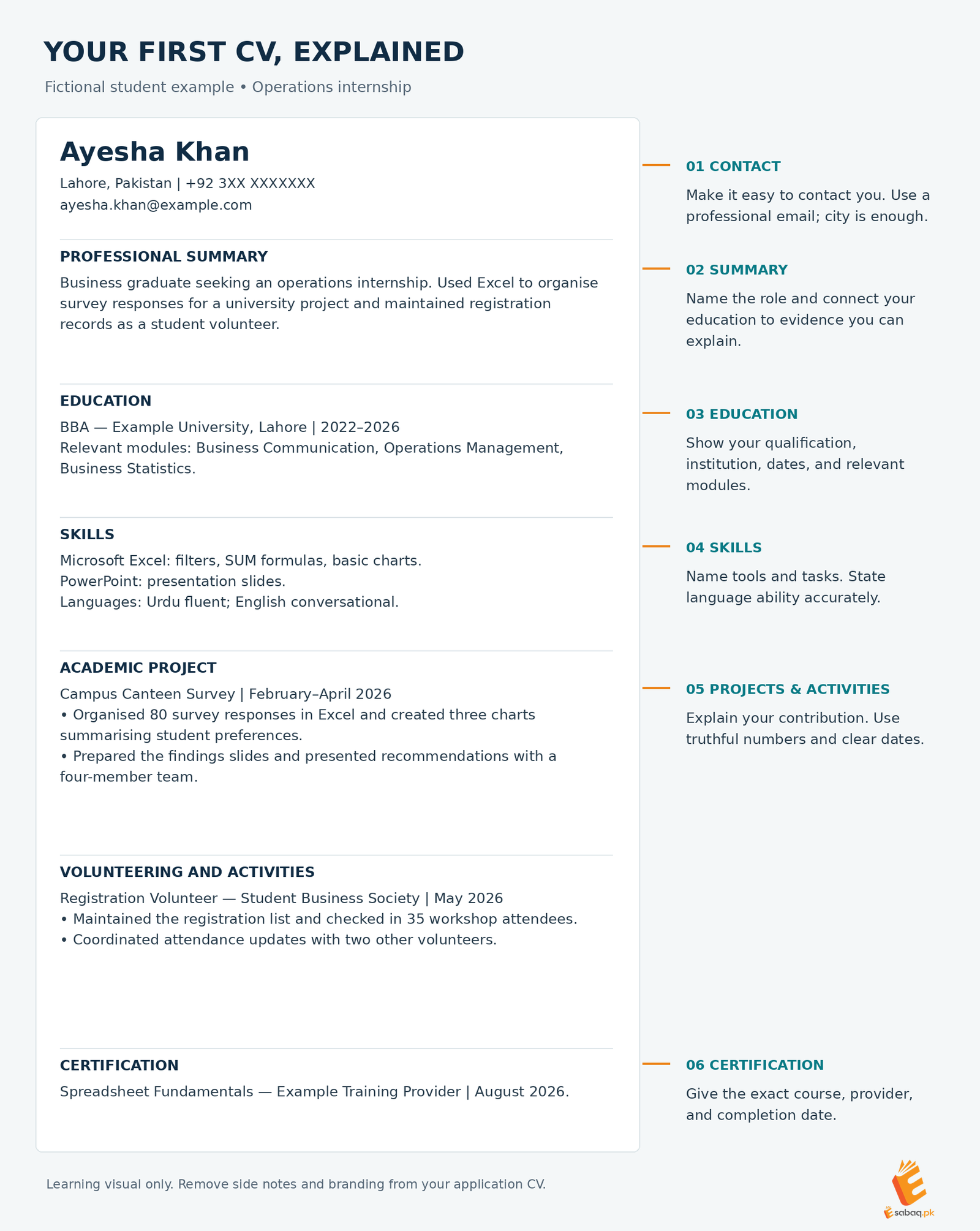
Fictional example: The applicant, education history, activities, certificate, and numbers below are illustrative. The email uses an example domain; the phone number is a placeholder. Do not copy these claims into your own application.
Ayesha Khan
Lahore, Pakistan | +92 3XX XXXXXXX | ayesha.khan@example.com
Professional summary
Business graduate seeking an operations internship. Used Excel to organise survey responses for a university project and maintained registration records as a student volunteer.
Education
BBA — Example University, Lahore | 2022–2026
Relevant modules: Business Communication, Operations Management, Business Statistics.
Skills
Microsoft Excel: filters, SUM formulas, basic charts. PowerPoint: presentation slides. Languages: Urdu fluent; English conversational.
Academic project
Campus Canteen Survey | February–April 2026
- Organised 80 survey responses in Excel and created three charts summarising student preferences.
- Prepared the findings slides and presented recommendations with a four-member team.
Volunteering and activities
Registration Volunteer — Student Business Society | May 2026
- Maintained the registration list and checked in 35 workshop attendees.
- Coordinated attendance updates with two other volunteers.
Certification
Spreadsheet Fundamentals — Example Training Provider | August 2026.
The side notes explain the sections. Remove annotations and eSabaq branding from your application CV; submit a text document, not this image.
Copy-and-fill first CV template
Use this first CV template as a starting point. Delete sections you cannot support and replace every bracketed item. Student CV examples should guide structure, not supply invented achievements.
[Full name]
[City, country] | [Phone] | [Professional email] | [Optional portfolio]
Professional summary
[Qualification or student status] seeking [specific role]. Demonstrated [relevant skill] through [real project or activity]. Able to contribute [task you can perform].
Education
[Qualification] — [Institution] | [Dates or expected completion]
[Relevant modules, project, or achievement]
Relevant skills
[Tool and tasks you can perform]
[Language and accurate proficiency]
Projects
[Project title and dates]
- [Action + task + tool or method + truthful result]
- [Your individual contribution]
Volunteering or activities
[Role, organisation or context, dates]
- [Responsibility and evidence]
Certifications
[Exact course title] — [Provider] | [Completion date or in progress]
Common mistakes to avoid
Do not apologise for having no experience or fill space with unsupported claims. Avoid invented job titles, borrowed achievements, incorrect dates, and long lists of unrelated interests. Remove spelling errors and unexplained abbreviations. Check that links work and that shared portfolio files are accessible without requesting permission.
If you use AI to improve wording, review every line. Keep your own facts and use language you could comfortably explain in an interview.
Frequently asked questions
Can I make a CV without any paid work?
Yes. Use education, projects, volunteering, and relevant responsibilities. Label unpaid or informal activities accurately and focus on what you contributed.
What if I have no projects or volunteering either?
Start with education and relevant coursework. Create a small role-related project, such as an expense tracker, and include it once you have actually completed it.
Should I include my photograph?
Usually, a first CV can focus on qualifications and skills. Follow genuine employer requirements if a photograph is specifically requested; expectations vary by application.
Do I need references on my first CV?
Include them when requested. Otherwise, keep the space for relevant evidence. Ask permission before sharing a teacher’s or supervisor’s contact details.
Can I send the same CV to every employer?
Keep a master copy, but adjust the summary, skill selection, and project order for each role. Every claim must remain accurate.
Your pre-submission checklist
- Confirm the role’s eligibility rules and deadline.
- Match your strongest examples to its requirements.
- Check names, dates, contact details, and spelling.
- Remove placeholders and unsupported claims.
- Confirm the requested format and sensible filename.
- Open the final attachment and test its links.
- Ask someone you trust to review it.
Start with one genuine achievement and build from there. For guided practice with CVs, communication, and job-search preparation, explore eSabaq.pk’s Career Building Short Course. Your next step today is to draft one page and tailor it to one real opportunity.
Leave A reply