 WhatsApp: +92 (308) 463-2275
Blog Details

Huroof-e-Muqattaat Teaching Chart: A Complete Visual Guide & Pronunciation Rules for Learners
Master Quranic isolated letters with our Huroof-e-Muqattaat teaching chart. Learn Tajweed elongation rules, Madd counts, and how to pronounce disjoined letters accurately with step-by-step guidance.
Huroof-e-Muqattaat Teaching Chart: A Complete Visual Guide & Pronunciation Rules for Learners
Reciting the opening verses of Surah Al-Baqarah (Alif-Laam-Meem) or Surah Maryam (Kaaf-Haa-Yaa-'Ayn-Saad) is often one of the most awe-inspiring moments for a student of the Holy Quran. Yet, for many beginners and young children, these unique letter combinations—known as Huroof-e-Muqattaat—present an immediate stumbling block. Students frequently confuse letter sounds with vowel diacritics, truncate prolonged letters, or skip mandatory nasalization (Ghunnah) between merged sounds.
Mastering these disjoined letters does not require years of Arabic fluency; it requires a structured visual roadmap. The esabaq.pk Huroof-e-Muqattaat teaching chart breaks down these mysterious combinations into clear phonetic groups, exact elongation counts (Madd), and visual color codes, making authentic Tajweed accessible to every home and classroom.
What Are Huroof-e-Muqattaat?
The term Huroof-e-Muqattaat (حُرُوف مُقَطَّعَات) translates linguistically to 'disjoined', 'separated', or 'isolated letters'. These letters appear at the very beginning of 29 Surahs in the Quran, immediately following the Basmalah.
Out of the 28 letters in the Arabic alphabet, exactly 14 letters form these openings—conveniently captured in the classic scholarly mnemonic sentence: نَصٌّ حَكِيمٌ قَاطِعٌ لَهُ سِرٌّ (Nassun Hakeemun Qaati'un Lahu Sirr – 'A wise text that is definitive and possesses a secret').
Unlike ordinary Arabic text where letters combine to form phonetic words (for example, ك-ت-ب reading as 'Kataba'), Huroof-e-Muqattaat must be articulated individually by their full alphabetical names (Kaaf, Laam, Meem). Each individual letter carries its own intrinsic duration and phonological rules.
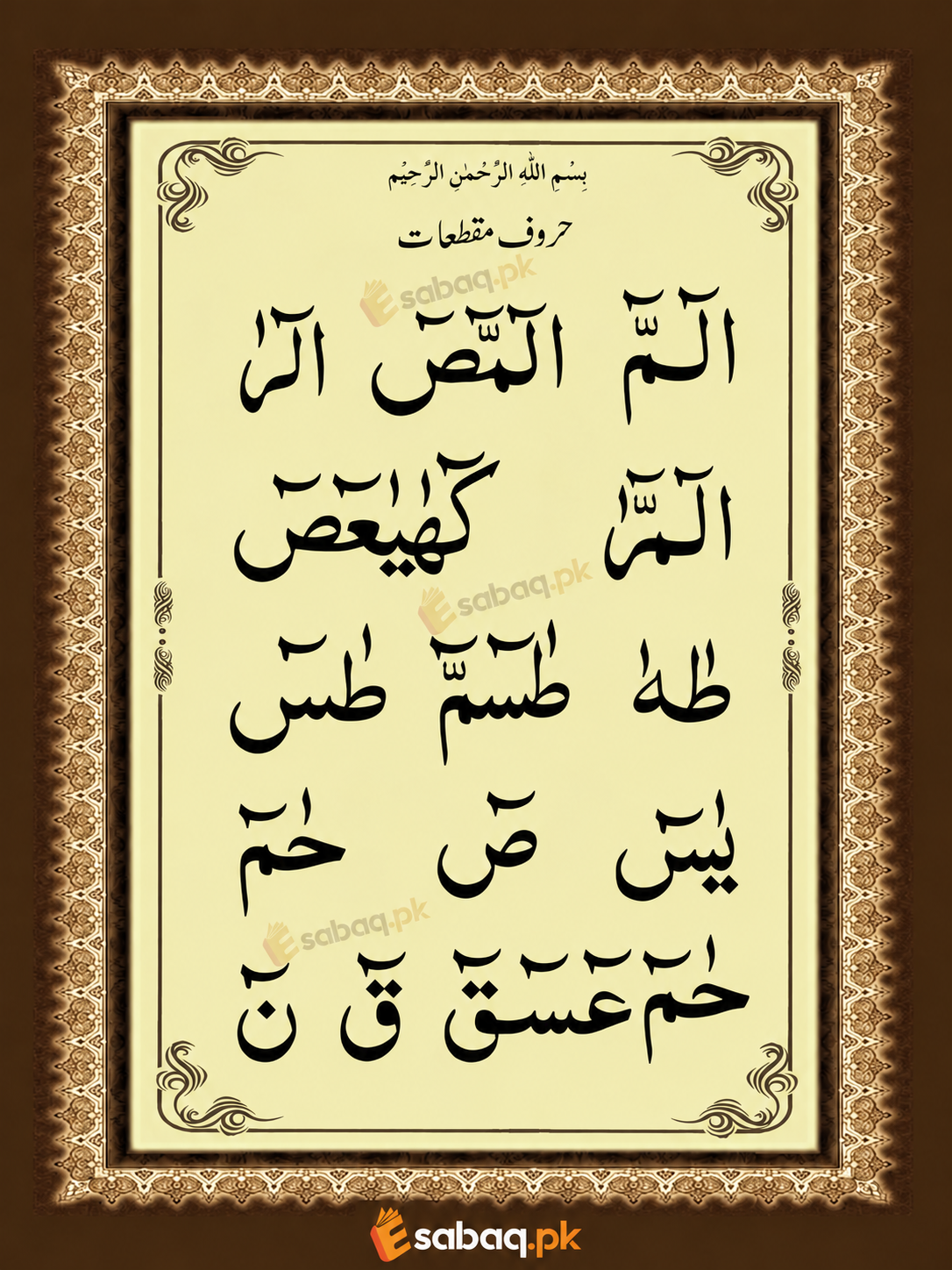
Huroof-e-Muqattaat Master Teaching Chart
The table below organizes the disjoined letter combinations found across the Quran, detailing their exact pronunciation lengths, phonetics, and critical Tajweed transitions:
|
Letter Combination |
Arabic |
Surahs |
Elongation & Phonetics |
Tajweed Rules to Apply |
|
Alif-Laam-Meem |
الم |
Al-Baqarah, Aal-e-Imran, Al-Ankabut, Ar-Room, Luqman, As-Sajdah |
• Alif: 0 counts |
Idgham Shafawi with Ghunnah (2 counts) during the transition from the end of Laam to the start of Meem. |
|
Alif-Laam-Meem-Saad |
المص |
Al-A'raf |
• Alif: 0 counts |
Same Idgham between Laam and Meem; clear Qalqalah on the final Daal sound of Saad when stopping. |
|
Alif-Laam-Raa |
الر |
Yunus, Hud, Yusuf, Ibrahim, Al-Hijr |
• Alif: 0 counts |
Izhar (clear sound) between Laam and Raa; no merging. Light, natural 2-count stretch on Raa. |
|
Alif-Laam-Meem-Raa |
المر |
Ar-Ra'd |
• Alif: 0 counts |
Idgham with Ghunnah between Laam and Meem; Raa held for 2 natural counts. |
|
Kaaf-Haa-Yaa-'Ayn-Saad |
كهيعص |
Maryam |
• Kaaf: 6 counts |
Ikhfa with Ghunnah (nasal concealment) between the final Noon sound of 'Ayn and the letter Saad. |
|
Taa-Haa |
طه |
Taa-Haa |
• Taa: 2 counts |
Pure Madd Tabee'i (natural prolongation); do not add a hamzah at the end. |
|
Taa-Seen-Meem |
طسم |
Ash-Shu'ara, Al-Qasas |
• Taa: 2 counts |
Idgham with Ghunnah between the Noon ending of Seen and the initial Meem. |
|
Taa-Seen |
طس |
An-Naml |
• Taa: 2 counts |
Clean transition without Ghunnah; full 6 counts on Seen. |
|
Yaa-Seen |
يس |
Yaa-Seen |
• Yaa: 2 counts |
Natural 2 counts on Yaa; full 6 counts on Seen. |
|
Saad |
ص |
Saad |
• Saad: 6 counts |
Heavy letter (Tafkheem), 6 counts duration, bold Qalqalah on the terminal Daal. |
|
Haa-Meem |
حم |
Ghafir, Fussilat, Az-Zukhruf, Ad-Dukhan, Al-Jathiyah, Al-Ahqaf |
• Haa: 2 counts |
Soft, throat-originating Haa (2 counts), followed by 6 counts on Meem. |
|
Haa-Meem; 'Ayn-Seen-Qaaf |
حم عسق |
Ash-Shura |
• Haa: 2 counts |
Two sequential verses: apply Ikhfa between 'Ayn and Seen, and another heavy Ikhfa between Seen and Qaaf. |
|
Qaaf |
ق |
Qaaf |
• Qaaf: 6 counts |
Deep uvular articulation with full 6 counts and crisp terminal Qalqalah. |
|
Noon |
ن |
Al-Qalam |
• Noon: 6 counts |
6 counts elongation; clear vocalization on the final letter. |
Core Tajweed Rules for Pronunciation
To read the chart accurately, students only need to categorize the 14 letters into three distinct elongation groups based on their phonetic spelling in Arabic:
1. Zero Elongation (No Madd)
· Letter: Alif (أَلِف)
· Tajweed Rule: When spelled in Arabic, Alif consists of three letters (أ - ل - ف) without any middle vowel letter (Harf Madd). Therefore, it receives 0 elongation counts and must be pronounced crisply as 'Alif' without stretching.
2. Natural Elongation (2 Harakat / Counts)
· Letters: ح , ي , ط , هـ , ر (Mnemonic: حَيٌّ طَهُرَ - Hayy Tahir)
· Tajweed Rule: When spelled out in Arabic, each of these letters consists of two letters ending in an Alif (حَا , يَا , طَا , هَا , رَا). They are categorized under Madd Tabee'i Harfi (Natural Letter Madd) and held for exactly 2 counts (approximately the time required to open or close a finger at an even pace).
· Common Mistake: Avoid closing the syllable with an artificial glottal stop (Hamzah). Say 'Haa', not 'Haa' '.
3. Maximum Elongation (6 Harakat / Counts)
· Letters: ن , ق , ص , ع , س , ل , م , ك (Mnemonic: نَقَصَ عَسَلُكُمْ - Naqasa 'Asalukum)
· Tajweed Rule: Spelled out with three letters containing a middle Madd vowel followed by an inherent Sukoon (e.g., لَامْ , مِيمْ , قَافْ). These letters constitute Madd Lazim Harfi (Compulsory Letter Madd) and must be prolonged for 6 full counts.
· Lightened (Mukhaffaf): If no assimilation follows the letter (e.g., Qaaf, Saad, Noon).
· Heavy (Muthaqqal): If the terminal sound merges into the following letter with a Shaddah (e.g., the ending of Laam merging into Meem in Alif-Laam-Meem).
· Special Case ('Ayn - ع): Because its middle vowel is a Leen letter (Yaa preceded by Fathah: عَيْن), reciters are permitted to prolong it for 4 or 6 counts, with 6 counts being the preferred standard in the Hafs 'an 'Asim narration.
Practical Tips for Teachers and Parents
Whether teaching at home or in an online Islamic classroom, these pedagogical strategies will accelerate your students' mastery:
1. Use Finger Taps for Rhythm: Beginners struggle with abstract time units. Have children tap their fingers on a desk (1 to 6) to physically measure Madd duration until muscle memory forms.
2. Isolate Transitions First: Before reading Alif-Laam-Meem in a single breath, practice the joint between Laam and Meem. Ensure the student holds the nasal buzz (Ghunnah) for two counts before opening into the Meem.
3. Color-Code the Teaching Chart: Highlight 2-count letters in green, 6-count Mukhaffaf letters in blue, and 6-count Muthaqqal letters in orange. Visual distinction significantly reduces cognitive load.
4. Prioritize Auditory Imitation: Tajweed is fundamentally an oral tradition passed down through qualified recitation. Always pair visual chart exercises with repeated teacher modeling and guided repetition.
|
Master Quranic Tajweed with Certified Tutors at esabaq.pk A visual chart provides the map, but a qualified teacher provides the compass. Misplaced tongue articulation points (Makharij) and subtle timing errors cannot be accurately diagnosed through self-study alone. ✔ One-on-One Live Feedback: Instant vocal corrections on your Madd counts, Ghunnah, and letter origins. ✔ Structured Visual Curriculum: Access interactive Noorani Qaida lessons, Huroof-e-Muqattaat exercises, and Tajweed workbooks. ✔ Flexible Scheduling: Classes available 24/7 across US, UK, Canada, Australia, and Pakistan time zones. 👉 Visit esabaq.pk to Book Your Free 3-Day Trial Class Today! |
Frequently Asked Questions (FAQs)
Q: How many Huroof-e-Muqattaat appear in the Holy Quran?
There are 14 unique Arabic letters that appear in 14 distinct combination forms across exactly 29 Surahs. All 29 occurrences appear exclusively at the very beginning of their respective chapters.
Q: Why are some letters pulled for 6 counts while others get only 2 counts?
Letters containing a middle vowel followed by an original permanent silence (Sukoon Asli) in their spelled root require maximum elongation (6 counts) to maintain balance, known as Madd Lazim. Letters that consist of only two letters ending in an Alif take a natural stretch of 2 counts (Madd Tabee'i).
Q: Can young children learn Huroof-e-Muqattaat before completing the Qaida?
Yes. Many educators introduce these letters as an engaging ear-training and rhythm exercise alongside mid-level Qaida lessons. Because they sound rhythmic and melodic, young students often memorize their pronunciations quickly when paired with visual charts and finger-tapping.
Leave A reply